
Castor oil has been applied to hair for centuries and gone viral on social media more times than anyone can count. Beauty influencers swear by it. The claims — thicker, longer, regrown hair in weeks — are compelling. The question is whether any of it holds up scientifically. The short answer is: not really. Here is what the evidence shows, what the theory behind castor oil is, and why an honest verdict matters more than a hopeful one.
The Short Answer
The best available evidence finds insufficient clinical evidence to support castor oil as an effective hair growth treatment. No peer-reviewed human randomised controlled trial has tested castor oil as a standalone hair loss treatment. The ricinoleic acid theory — the main scientific rationale — remains unconfirmed at clinically relevant doses in humans.
That does not mean castor oil is useless. It is a legitimate conditioning agent that can improve hair appearance. But appearance and regrowth are not the same thing.
What Castor Oil Is and Why People Think It Works
Castor oil is pressed from the seeds of Ricinus communis. Its defining characteristic is an unusually high ricinoleic acid content — around 85–90% by composition. Most plant oils contain oleic or linoleic acid; castor oil’s ricinoleic acid profile is chemically distinctive.
The theory connecting ricinoleic acid to hair growth goes like this:
- Ricinoleic acid may act as an agonist at the prostaglandin EP2 receptor
- Prostaglandin pathway drugs — specifically bimatoprost and latanoprost, ophthalmic medications — are used clinically to stimulate eyelash growth, and they work through a related mechanism
- If ricinoleic acid mimics this pathway, the reasoning goes, perhaps it stimulates hair follicles too
This is a plausible mechanism on paper. The problem is the distance between “plausible on paper” and “confirmed in human clinical trials” is enormous.
Bimatoprost has Phase III trial data supporting its eyelash effects. Those trials tested an actual pharmaceutical compound at precise doses in controlled conditions. What has not been done is a human RCT applying castor oil to scalp hair at typical topical concentrations and measuring regrowth against a control. That trial does not exist.
There is preclinical data worth noting: some animal studies using a 35% castor oil lotion found improved hair thickness and length in animal models. Animal results do not transfer automatically to humans, and a 35% lotion is not what people are rubbing into their scalps at home. This is context, not evidence of human efficacy.
What the Systematic Review Found
A 2022 systematic review published in the Journal of Drugs in Dermatology (JDD) examined coconut, castor, and argan oil for hair health in patients with skin of colour. Researchers reviewed 22 articles across all three oils.
Their conclusion on castor oil was direct: insufficient evidence to support castor oil as an effective hair growth treatment.
What did the review find castor oil does support? Improved hair luster and shine. That is a cosmetic conditioning effect — real and meaningful for hair appearance, but not therapeutic. There is a difference between a hair that looks better and a follicle that has resumed producing hair.
A 2024 three-arm RCT comparing rosemary compounds to castor oil also merits attention here. That trial found activity in the rosemary arm. Castor oil was not identified as the active ingredient. The study does not validate castor oil as a standalone hair growth agent — if anything, it illustrates the problem with assuming castor oil deserves credit when used alongside other ingredients.
As of 2026, no new randomised controlled trial has been published that changes this verdict.
What the Theory Predicts vs. What the Evidence Shows
| Claim | Status |
|---|---|
| Ricinoleic acid activates EP2 prostaglandin receptor | Theoretical; not confirmed at clinical doses in human scalp RCTs |
| Animal studies show hair improvement with castor oil | True for some animal models at 35% lotion concentration; not replicated in human clinical trials |
| Castor oil grows hair (TikTok/beauty claims) | Anecdotal; no controlled human evidence |
| Castor oil improves hair luster and condition | Supported by evidence — this is a cosmetic effect |
| Castor oil is equivalent to bimatoprost/latanoprost | Not supported; the mechanism is extrapolated, not tested |
The gap between the theory and the clinical evidence is not small. It is the difference between a plausible hypothesis and a proven treatment. Those are not the same thing, and conflating them does people a disservice — particularly anyone who is experiencing hair loss serious enough to act on.
Safety Notes — Felting and Alopecia Areata
Most safety discussions about castor oil end with “it is generally safe” and move on. There are two risks worth knowing about.
Hair felting. Castor oil can cause acute hair felting: severe, irreversible matting of the hair shaft that can be impossible to undo without cutting. This is not a rare theoretical risk — it has been documented in the medical literature. PMC5596646 describes cases of castor oil-induced felting, which occurs because the oil’s high viscosity causes individual hair fibres to become physically entangled and matted together when applied heavily or left in overnight. Felted hair is not treatable with conditioner; it often requires cutting.
Alopecia areata. If you have been diagnosed with alopecia areata — the autoimmune form of hair loss — castor oil is not appropriate as a self-treatment. Castor oil is not a treatment for autoimmune hair loss, and applying it does not address the underlying condition. People with alopecia areata should be working with a dermatologist on evidence-based interventions (such as JAK inhibitors or corticosteroid injections), not applying a cosmetic oil and hoping for the best. This distinction matters because alopecia areata is frequently misidentified by the people experiencing it.
How Does It Compare to Proven Treatments?
Context matters here. The question is not just whether castor oil has evidence — it is what the alternative evidence landscape looks like.
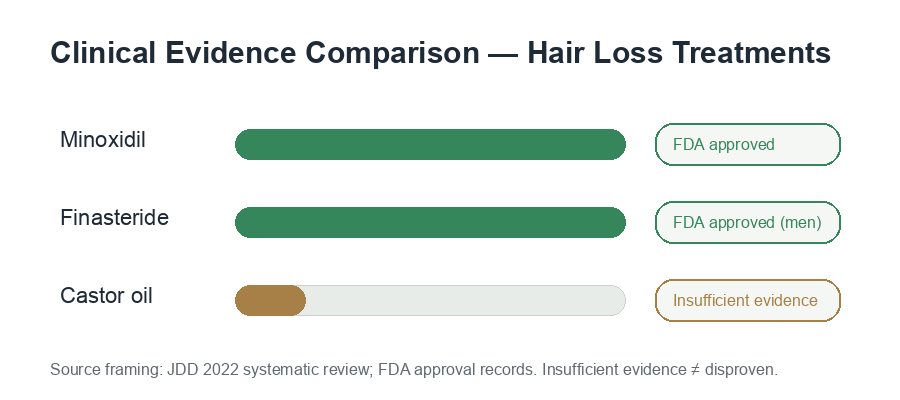
Castor oil lacks the clinical trial evidence base of proven hair loss treatments. That does not mean it cannot work — only that current evidence is insufficient to confirm it does.
Minoxidil (topical and oral): Multiple large RCTs. FDA-approved specifically for hair loss. Established mechanism involving potassium channel opening and follicle miniaturisation reversal. The benchmark for over-the-counter hair loss treatment.
Finasteride: Phase III trial data. Proven DHT-pathway mechanism for androgenetic alopecia in men.
Rosemary oil: A 2023 RCT found rosemary oil at 2% comparable to minoxidil 2% for androgenetic alopecia over six months. This is not Phase III data, but it is an actual controlled human trial with a control arm.
Castor oil: No human RCT for hair loss. No regulatory review. Systematic review conclusion: insufficient evidence.
Castor oil is not a treatment in the same category as these options. At best it is a cosmetic conditioning product with an interesting but unconfirmed theoretical mechanism. For anyone with a diagnosed hair loss condition — androgenetic alopecia, telogen effluvium, alopecia areata — castor oil is not an evidence-based intervention.
This does not mean you cannot use it. It means you should not use it instead of something that actually works, and you should not expect it to do what proven treatments do.
If You Still Want to Use Castor Oil
None of the above makes castor oil dangerous in reasonable amounts for most people. If you want to use it as a scalp or hair conditioning treatment:
- Use sparingly. A few drops massaged into the scalp is appropriate. Not a thick coat left overnight.
- Do not soak long hair in it. Felting risk is real. Apply with restraint.
- Do not expect regrowth. The realistic expectation is improved hair texture, shine, and possibly scalp moisturisation. That is worth something as a cosmetic goal; it is not hair loss treatment.
- Do not use it if you have alopecia areata. This is an autoimmune condition. Speak to a dermatologist.
- Do not delay proven treatment. If you are losing hair and have not spoken to a dermatologist or tried minoxidil, castor oil should not be your first step. Evidence-based options exist and they work.
- Jamaican black castor oil is not different in efficacy. It is processed differently — roasted beans, different pH — but there is no evidence it has superior hair growth effects compared to cold-pressed castor oil. The category-level evidence problem applies to both.
FAQ
Does castor oil grow hair? There is no quality clinical evidence from human RCTs that it does. The 2022 JDD systematic review found insufficient evidence to support castor oil as a hair growth treatment. As of 2026, no new trial has changed this verdict.
What does ricinoleic acid do for hair? The proposed mechanism is that ricinoleic acid acts on the prostaglandin EP2 receptor, potentially influencing hair follicle behaviour. This is a theoretical mechanism extrapolated from pharmaceutical prostaglandin drugs. It has not been confirmed in human clinical trials at the concentrations found in typical topical castor oil application.
Can castor oil damage hair? Yes. Heavy or overnight application — particularly on long hair — can cause hair felting: severe, irreversible matting documented in medical literature (PMC5596646). Apply sparingly.
Is Jamaican black castor oil different? It is produced using roasted castor beans, which changes the oil’s pH and gives it a distinct colour and smell. There is no evidence of a different efficacy profile for hair growth. The clinical evidence gap applies equally to both.
Is castor oil safe if I have alopecia areata? No. Alopecia areata is an autoimmune condition that does not respond to cosmetic oils. Castor oil cannot treat the underlying mechanism and is not appropriate as a self-treatment substitute. Work with a dermatologist on evidence-based interventions.
What actually works for hair loss? For androgenetic alopecia (the most common type), oral minoxidil and topical minoxidil have the strongest evidence base. Finasteride has proven efficacy in men. Rosemary oil has one RCT supporting activity comparable to minoxidil 2%. See our evidence ranking for hair growth supplements for broader context on what the evidence actually supports.
The Bottom Line
Castor oil’s story is a case study in how a plausible mechanism and decades of beauty culture can generate more confidence than the science warrants. Ricinoleic acid has an interesting theoretical pathway to hair follicle stimulation. The systematic review is clear that clinical proof does not exist — and nothing published since has changed that.
Use it as a conditioning product if you like it. Go easy on the amounts to avoid felting. If you have alopecia areata, skip it and see a dermatologist. And if you are dealing with actual hair loss — more hair coming out than is normal — spend your energy on interventions that have been tested and proven, not on a theory that has not cleared the clinical bar.