
The short answer: The best available evidence says no. A 2025 randomized controlled trial — the most rigorous study done on this question — found no significant effect of creatine supplementation on hair density, hair thickness, or scalp DHT levels. The viral claim that creatine causes hair loss traces back to a single small 2009 study that has never been replicated and never actually measured hair loss at all.
Why This Question Keeps Coming Up
Creatine is one of the most popular sports supplements in the world, with decades of safety data and strong evidence for improving power output and recovery. Yet ask in any gym or fitness forum whether creatine causes hair loss, and you’ll find hundreds of people convinced it does.
That belief comes almost entirely from one source: a 2009 study on college rugby players that showed elevated levels of a hormone called dihydrotestosterone (DHT) after a creatine loading phase. Since DHT is linked to male pattern baldness, the internet connected the dots: creatine → DHT → hair loss.
The problem is that the connection is much more complicated than that — and a large body of evidence, including a high-quality 2025 trial, has not been able to confirm it.
The 2009 Study: What It Actually Found
The original paper, published in the Clinical Journal of Sport Medicine in 2009, studied 20 rugby players who took a creatine loading phase (25g/day for 7 days) followed by a maintenance dose (5g/day for 14 days). Compared to placebo, the creatine group showed a statistically significant increase in the ratio of DHT to testosterone.
Important caveats that often get left out of the gym discussion:
- The study measured serum DHT (DHT in the bloodstream) — not DHT in the scalp, not hair follicle DHT activity, and not hair loss.
- There were only 20 participants. Statistical significance in a study this small can reflect noise.
- Neither group experienced any measurable hair loss during the study.
- The serum DHT levels, while elevated relative to placebo, remained within the normal reference range.
This study was never replicated. Multiple attempts to find the same effect in subsequent research failed to confirm it. The 2009 study is still the primary — and arguably only — direct evidence cited for the creatine–DHT–hair loss chain, yet it only confirmed one weak link in that chain, under a loading protocol that most recreational users don’t follow.
The 2025 RCT: The Most Definitive Evidence to Date
In April 2025, the Journal of the International Society of Sports Nutrition published the most rigorous study on this question to date (PMC12020143): a 12-week, double-blind, placebo-controlled randomized trial in resistance-trained men taking 5g of creatine per day — the standard maintenance dose.
Researchers measured:
- Testosterone
- Free testosterone
- DHT (serum)
- Hair density
- Follicular unit count
- Hair shaft thickness
The result: No statistically significant differences between the creatine and placebo groups on any of these measures.
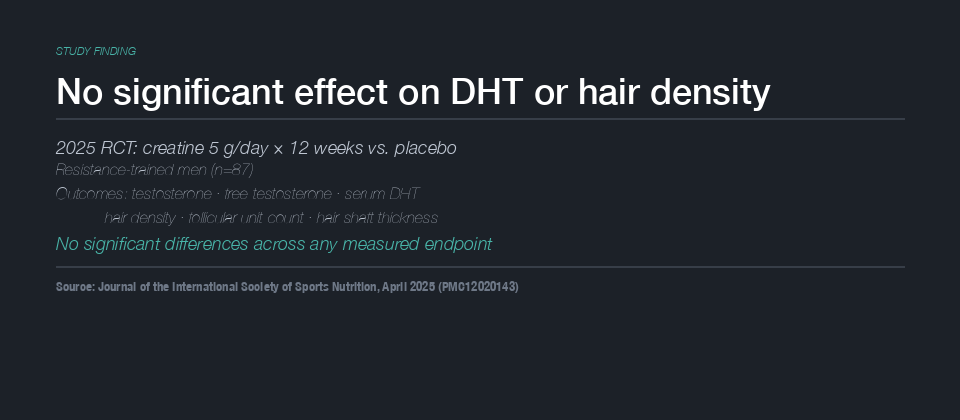
The American Hair Loss Association cited this study as “the most definitive evidence to date” that creatine supplementation does not negatively affect scalp hair at standard doses.
This is the study that should be at the centre of every creatine and hair loss conversation. It directly measured hair outcomes — not just a proxy hormone — over a clinically relevant time period, in men who were actually training.
Why Serum DHT Doesn’t Directly Cause Hair Loss
Even setting aside the 2025 RCT, the biological logic underlying the creatine–hair loss fear is shakier than it appears.
Hair loss in male pattern baldness (androgenetic alopecia) is not simply caused by having DHT in the bloodstream. It depends on:
- Genetic sensitivity of hair follicles to DHT — specifically, the androgen receptors within the follicle
- 5-alpha reductase type II activity in the scalp, which converts testosterone to DHT locally within follicles
- Individual variation in how follicles respond to androgenic signalling
A man with no genetic predisposition to pattern baldness can have elevated serum DHT and experience minimal follicular effects. A man with high genetic sensitivity can lose hair despite DHT levels that look normal on a blood test.
Serum DHT — what the 2009 study measured — is not the same thing as scalp DHT, and scalp DHT is not the same thing as follicle sensitivity. The chain from “creatine may slightly elevate serum DHT in some loading protocols” to “creatine causes hair loss” skips several biologically important steps.
What Systematic Reviews Show
Multiple systematic reviews published since 2009 have attempted to evaluate whether creatine supplementation reliably increases DHT levels. Among the most comprehensive is the 2022 International Society of Sports Nutrition position stand (Kreider et al., JISSN 2022), which reviewed the full body of evidence on creatine safety and found no credible evidence linking standard-dose creatine to adverse androgenic effects on hair.
The consistent finding across reviews: at standard maintenance doses (3–5g/day), there is no confirmed signal for elevated DHT. The 2009 loading protocol finding has not been reproduced at the doses and durations that most people actually use creatine.
No systematic review has found evidence that creatine supplementation causes measurable hair loss.
What If You’re Genetically Predisposed to Hair Loss?
If you have a strong family history of male pattern baldness, it’s reasonable to wonder whether any possible DHT-related effect from creatine matters specifically for you. The honest answer is: probably not.
Here’s why:
- The 2025 RCT measured hair density and follicular unit count in resistance-trained men. It found no difference. The study did not specifically stratify by family history, so we can’t say with certainty what happens in men with the highest genetic sensitivity — but the absence of any signal across the whole group is reassuring.
- If your hair is actively thinning, the cause is almost certainly your genetics (androgenetic alopecia) and the natural progression of pattern hair loss — not your creatine supplement. Effective treatments exist for pattern hair loss, and stopping creatine is unlikely to change the trajectory.
- If you are on finasteride or another 5-alpha reductase inhibitor for hair loss, that medication directly reduces DHT conversion. Any theoretical marginal effect of creatine on serum DHT would be substantially blunted by the medication.
If you’re noticing significant hair shedding and you’re concerned, the right step is to see a GP or dermatologist — not to stop creatine.
Should You Stop Taking Creatine Because of Hair Loss Concerns?
Based on current evidence: no.
The 2025 RCT found no effect on hair density, follicular units, or shaft thickness over 12 weeks at a standard dose. The 2009 serum DHT finding has not been replicated at standard doses. No study has ever observed creatine directly causing hair loss.
Creatine is one of the most extensively studied sports supplements in existence. If you’re using it for performance or recovery reasons and you’re worried about your hair, the evidence does not support stopping it.
If your hair is thinning, the cause is almost certainly pattern hair loss driven by genetics — a well-understood condition with several evidence-based treatments available.
Frequently Asked Questions
Does creatine increase DHT? The evidence is mixed and largely not reproducible. One 2009 study found elevated serum DHT during a short creatine loading phase (25g/day for 7 days). Multiple subsequent studies at standard doses (3–5g/day) have not replicated this finding. The 2025 RCT specifically found no difference in DHT between creatine and placebo groups over 12 weeks.
Can creatine cause a receding hairline? There is no clinical evidence that creatine causes or accelerates hairline recession. A receding hairline in men is almost universally caused by androgenetic alopecia — a genetic condition influenced by DHT sensitivity in follicles. Creatine has not been shown to meaningfully affect this process.
What if I noticed more shedding when I started creatine? Temporal association isn’t the same as causation. Hair shedding that appears after starting a new supplement is often coincidental — the timing feels meaningful because we’re primed to look for explanations. It can also help to understand what counts as normal hair loss before drawing conclusions. Diffuse shedding can have many causes including stress, nutritional deficiencies, hormonal changes, and the natural progression of pattern hair loss. If shedding is significant and persistent, see a dermatologist rather than attributing it to creatine.
I have male pattern baldness. Should I avoid creatine? The current evidence does not suggest you need to avoid it. The 2025 RCT found no adverse hair effects at standard doses. If you have AGA and are concerned, discuss with a dermatologist — they can advise on proven DHT-related treatments like finasteride and whether creatine use matters for your specific situation.
Does creatine affect hair growth at all? No positive or negative effect on hair growth has been established. Creatine works by replenishing phosphocreatine stores in muscle tissue during high-intensity exercise. Its mechanism of action has no known direct relationship to the hair growth cycle.
The Bottom Line
The creatine and hair loss story is a case study in how a single small study — misrepresented on its way through the internet — can become an enduring fitness myth.
The original 2009 paper never measured hair loss. It found a possibly elevated DHT-to-testosterone ratio in a short loading protocol that most people don’t use, in 20 participants. That finding has not been replicated at standard doses.
The 2025 randomized controlled trial directly measured hair density, follicular units, and hair shaft thickness in men taking creatine for 12 weeks. It found nothing.
If you’re taking creatine for performance reasons and you’re worried about your hair, you can stop worrying. If your hair is thinning, the cause is almost certainly your genetics — not your supplement stack.
This article is for informational purposes and reflects the evidence available as of April 2026. It is not medical advice. If you’re experiencing significant hair loss, speak with a GP or dermatologist.