
Scalp massage is cheap, requires nothing but your hands, and has been recommended for hair loss since long before anyone ran a clinical trial on it. That alone makes it worth scrutinizing.
But here’s the thing: there is real clinical evidence for scalp massage — enough to take seriously, not enough to call it a treatment. This article breaks down what the research actually shows, including a small but properly-designed 2016 controlled study, a larger 2019 survey, and the emerging mechanistic evidence — alongside what none of it proves.
The short version: scalp massage is a reasonable, free adjunct to proven hair loss treatments. It is not a standalone therapy. It is not comparable to minoxidil. But it probably isn’t doing nothing, either.
The Short Answer
Scalp massage has credible mechanistic evidence: it physically stretches the cells in your hair follicles in ways that appear to activate hair-growth genes. A small controlled study showed real improvements in hair shaft thickness. A large self-reported survey found that most people with androgenic alopecia (AGA) who did it consistently reported reduced shedding.
What it doesn’t have: a large, blinded, placebo-controlled trial showing it stops or reverses AGA at the scale that minoxidil or finasteride do.
How to think about it: An evidence-supported add-on to a proper hair loss treatment plan. Worth doing if you’re already treating your hair loss. Not sufficient on its own.
How Scalp Massage Might Actually Work
The reason scalp massage isn’t pure wishful thinking comes down to a specific biological mechanism.
Your hair follicles sit in a layer called the subcutaneous tissue. Each follicle is anchored to a cluster of specialized cells called the dermal papilla — and these cells control whether the follicle is in the growth phase (anagen), the regression phase (catagen), or the resting phase (telogen).
Here’s the key finding: dermal papilla cells are mechanosensitive. Physical pressure and stretching changes what genes they express.
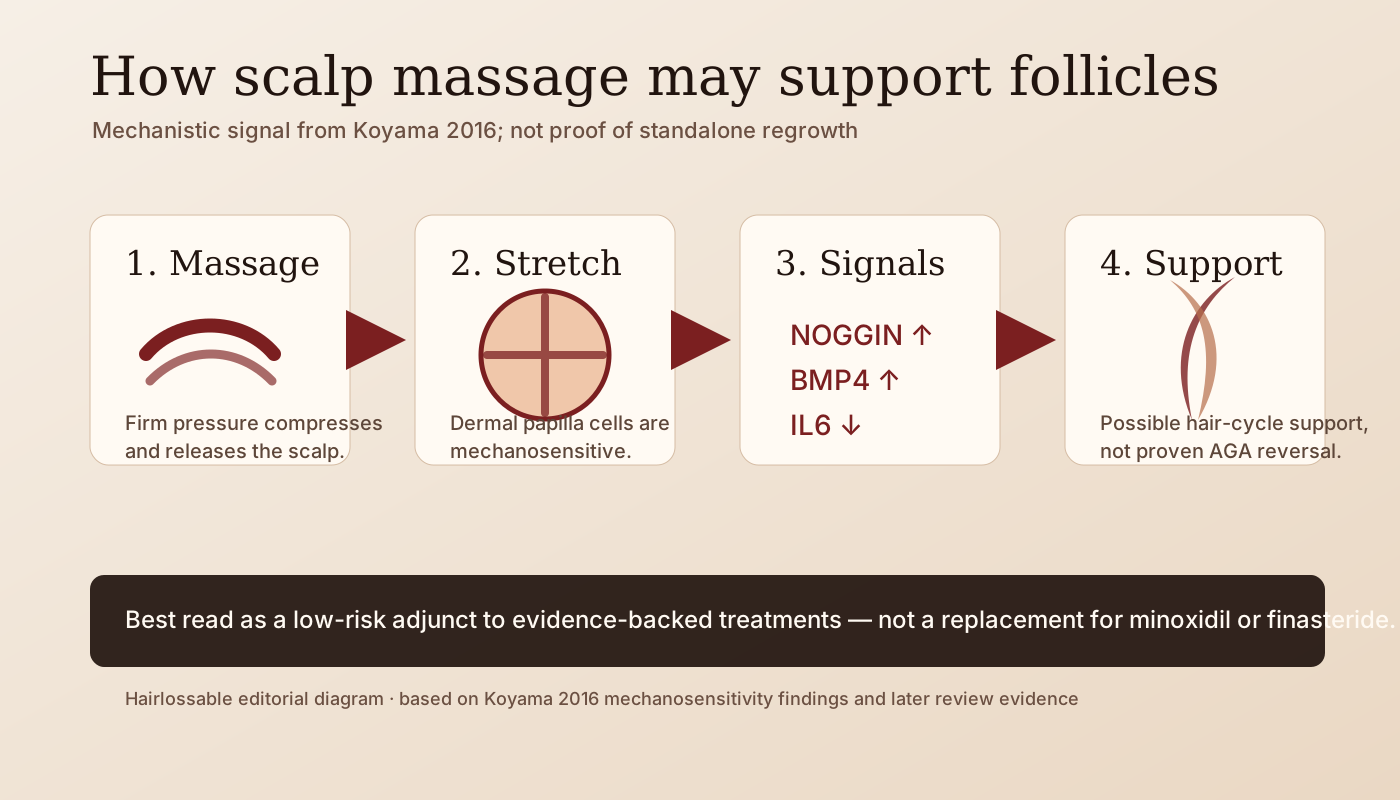
A 2016 laboratory study by Koyama et al. (PMC4740347) showed that when dermal papilla cells experience mechanical stretching — the kind produced by scalp massage — they upregulate genes associated with hair growth, including NOGGIN and BMP4, while downregulating IL6, a signaling molecule associated with follicle regression.
In plain terms: physically compressing and releasing the scalp appears to activate the cells that tell hair follicles to grow, and quiets the ones that signal them to stop.
This mechanism was further supported by a 2025 systematic review in SAGE Journals (doi:10.1177/20417314251362398) on mechanical stimulation for hair regeneration. The authors confirmed that dermal papilla mechanosensitivity is a valid biological pathway — but noted that in vitro and animal evidence is considerably stronger than current human clinical evidence. The mechanism is credible. The clinical proof of concept is still early-stage.
The 2016 Study: What the Controlled Evidence Actually Shows
The most important study for scalp massage was published in 2016 by Taro Koyama and colleagues. Here’s exactly what it found — and what it didn’t.
Study design: 9 healthy Japanese men. Standardized scalp massage using a device, 4 minutes per day, for 24 weeks.
Result: Significantly increased hair shaft thickness compared to baseline. The researchers also documented gene expression changes in dermal papilla cells consistent with the mechanosensitivity mechanism above.
Limitations you should know:
- n=9 is very small — this is a proof-of-concept study, not a treatment trial
- Participants were healthy men with no hair loss — not people with AGA
- The study measured hair shaft thickness, not hair regrowth, hair count, or AGA progression
- The massage was delivered by a standardized device, not manual technique
This is the strongest clinical evidence for scalp massage. It’s a real finding that validates the mechanism. It is not, on its own, evidence that scalp massage treats hair loss.
The 2019 Survey: The Larger Signal
The 2016 study is controlled but tiny. The 2019 follow-up by Koyama et al. (PMC6380979) enrolled far more people — but traded rigor for scale.
Study design: 340 male AGA patients, self-reported online survey. Participants had performed a standardized scalp massage protocol over varying durations.
Result: 68.9% reported stabilization of hair loss or improvement in hair density.
Critical limitation you need to understand: This was entirely self-reported. There were no objective hair counts, no clinician-reviewed photographs, no placebo group, no blinding. The 68.9% figure represents the percentage of participants who felt their hair had improved — not a clinically measured outcome.
The time commitment finding: Participants who reported positive outcomes averaged approximately 36.3 total hours of cumulative massage. At common daily durations of 11–20 minutes, that implies roughly 5+ months of consistent practice. The study authors suggested a minimum threshold of 50 total hours to meaningfully gauge whether scalp massage is working for any individual.
A distinction almost no competing article makes clearly: These are two very different studies. The 2016 study is a controlled trial measuring objective hair thickness in healthy men without hair loss. The 2019 study is a self-reported survey of AGA patients. Treating both as equivalent evidence inflates the apparent quality of the research base — and most articles covering this topic do exactly that.
What the Evidence Does NOT Show
To be direct about the gaps:
- No large-scale RCT exists. No trial has enrolled hundreds of AGA patients, randomized them to massage vs. no-massage, measured objective hair counts at 12 months, and published the results.
- No head-to-head comparison with minoxidil has been done.
- The 2016 study’s subjects didn’t have hair loss. You cannot directly extrapolate from “scalp massage thickened hair shafts in healthy men” to “scalp massage slows AGA progression.”
- The 2019 survey’s 68.9% is not a clinical success rate. It is the percentage of self-selected participants who reported a positive impression of their own hair.
- UCLA Health has published that evidence for scalp massage in hair loss is “inconclusive” — that’s the honest authoritative summary.
None of this means scalp massage doesn’t work. It means the evidence isn’t strong enough to be certain. That matters because it determines how to use it: as an adjunct to evidence-backed treatments, not as a plan.
Scalp Massage and Minoxidil
If you’re already using minoxidil, adding scalp massage is clinically reasonable and low-risk.
The theoretical rationale: scalp massage increases local blood flow to follicles and may improve penetration of topical minoxidil through the scalp. No direct RCT has tested this combination. The case for it rests on the plausibility of both mechanisms operating through different pathways simultaneously.
This is not “scalp massage makes minoxidil work better” with evidence. It is “scalp massage probably doesn’t interfere with minoxidil, has its own independent mechanistic rationale, and the only cost is time.”
For those using combination approaches like minoxidil and finasteride, scalp massage fits comfortably as a no-risk adjunct to an already evidence-backed regimen.
How to Do Scalp Massage
Duration: The 2016 study used 4 minutes per day — the minimum protocol with controlled evidence. The 2019 survey data suggests 11–20 minutes per day correlates with better self-reported outcomes. The honest framing: 4–5 minutes daily is worth doing; more time appears to produce more benefit, but the supporting data is self-reported.
Frequency: Daily is ideal. Three to four times per week still delivers repeated mechanical stimulus.
Technique: Use firm but gentle circular pressure with your fingertips. The goal is to gently compress and lift the scalp against the skull — not to slide fingers along the hair shafts, which can cause breakage and tangling. Cover the full scalp rather than concentrating on one area.
Manual vs. device: The 2016 study used a standardized massage device. Most real-world guidance extrapolates to manual massage — the mechanical principle is the same. Vibrating scalp massager tools (including the ones that went viral on TikTok) likely deliver mechanical stretching force, but whether they replicate the exact force parameters of the study device is unknown. They are a reasonable option for consistent daily use.
When: Before or after applying topical minoxidil. Either works.
What to avoid: Aggressive friction rubbing along the hair shaft. Massage on an inflamed or actively irritated scalp (seborrheic dermatitis, psoriasis flares). Expecting results in a few weeks — the 2016 study ran 24 weeks; the 2019 survey implied 50+ cumulative hours.
Frequently Asked Questions
Does scalp massage really grow hair?
The evidence shows scalp massage can increase hair shaft thickness in healthy men (n=9, 2016 controlled study) and that AGA patients who do it consistently often self-report reduced shedding (2019 survey, 68.9%). There is no large RCT demonstrating that scalp massage regrows hair or reverses AGA. The evidence supports it as an adjunct — not as a proven hair loss treatment.
How long does scalp massage take to see results?
The 2016 controlled study found hair thickness changes after 24 weeks of 4 min/day massage. The 2019 survey data suggested 50+ total hours of cumulative massage as a threshold for gauging therapeutic potential — at 11–20 minutes per day, that means roughly 5–7 months. This is not a fast-acting intervention.
Is a scalp massager device better than doing it manually?
The only controlled study used a standardized massage device. Manual massage extrapolations are based on the same mechanical principle. There is no direct comparison trial between device and finger massage. Either approach delivers mechanical stimulation — consistency of pressure and daily adherence matters more than the specific tool.
Can scalp massage replace minoxidil?
No. There is no clinical trial in which scalp massage produced results comparable to minoxidil in AGA. Minoxidil and finasteride have decades of large controlled-trial evidence behind them. Scalp massage does not. Use it as a supplement to evidence-backed treatments, not as a substitute.
Should I do scalp massage if I’m already on minoxidil?
Yes — it’s a reasonable, low-risk addition. No trial has proven a synergistic benefit, but there is no evidence of interference, and the independent mechanistic rationale for scalp massage is credible. See the technique section above for timing guidance.
The Bottom Line
Scalp massage has a more credible evidence base than almost any other low-cost, non-pharmacological hair intervention. The mechanism is real and well-characterized at the cellular level. The 2016 study is small but properly controlled. The 2019 survey is large but self-reported.
What this adds up to: a free, low-risk adjunct worth incorporating if you’re already treating hair loss with minoxidil, finasteride, or a combination approach. It belongs in the same category as microneedling for hair loss — a mechanical intervention with legitimate mechanistic support and early-stage clinical signals, not a primary treatment.
As a standalone approach to AGA, the evidence simply isn’t there. But as something you add to a real treatment plan — especially one that costs nothing but 4–20 minutes of daily consistency — it earns its place.
If you’re not sure where to start with hair loss treatment, understanding what normal daily hair shedding looks like is a useful first step before evaluating any intervention.